



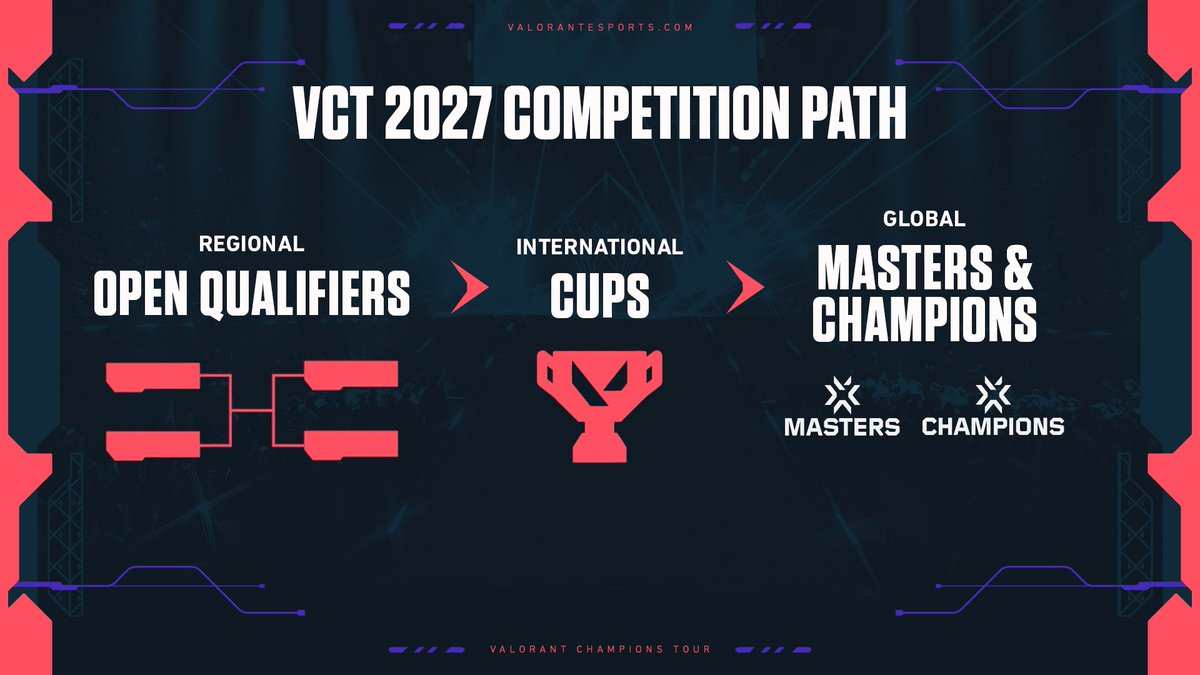
Riot Games has finally lifted the curtain on the new look VALORANT Champions Tour for 2027, and it is a much bigger shake-up than most people expected. The publisher says the VCT is moving to an all-tournament model built around higher stakes, open access to global events, and more live events in more cities around the world. Riot also confirmed that every path to Masters and Champions will now begin with open qualifiers, which is a massive shift from the more closed ecosystem fans have known in recent years.
At a glance, the new system is built on a few clear ideas. Every match is supposed to matter more, the road to international competition is supposed to be more open, and the VCT itself is supposed to feel more global by bringing events closer to regional fans. That means more tournaments, more LANs, more chances for unsigned or non-partner teams, and a competition calendar that looks a lot more aggressive than before.
VCT 2027 is moving to an all-tournament format
The biggest headline is simple. Riot is replacing the old regular-season league structure with a tournament-based system in 2027. According to the official announcement, the VCT will shift to a model where open qualifiers feed into new events called Cups, and those Cups will lead directly into Masters and Champions. Riot says this is meant to create more high-stakes moments throughout the season and make the path to top-tier competition far more accessible.
That change alone makes the new VCT feel very different. Instead of a long league grind where access to the top is limited, Riot wants a structure where teams can make repeated runs at major events across the season. It feels more fluid, more dangerous, and honestly more exciting for both viewers and teams trying to break through.
Open qualifiers will now lead to every major VCT event
One of the most important changes is that all Masters and Champions qualification paths will start with open qualifiers. Riot says any team across the world will have a shot, and that qualification routes may include community tournaments, partner events, collegiate play, Premier, and more. The company has not shared every rule yet, but the direction is obvious. The gate is opening wider.
That is a huge contrast to previous seasons, where non-partner teams often had to survive an entire year just for one promotion opportunity through Ascension. In 2027, Riot says teams will have multiple opportunities during the year to reach the biggest stages in VALORANT esports. For up-and-coming rosters, that could completely change how organizations invest in the scene.
New VCT Cups will replace regular-season league play
Riot is introducing VCT Cups as the backbone of the new system. These Cups will be LAN-based tournaments, with two per territory each year and eight in total across the ecosystem. Riot says they will replace regular-season league play, end with finals weekend events, and directly qualify teams into Masters and Champions.
That last part is what really matters. These are not side events or filler stops on the calendar. Cups are central to the whole competitive structure now. If Riot executes this well, every event should feel meaningful instead of just serving as setup for something bigger later.
More LAN events and roadshows are coming to the VCT
Riot also says Kickoff and Cups will be played on LAN using a mix of Riot studios and custom venues. In total, the company expects the VCT to host more than 20 tournaments every year while visiting more than 16 cities around the world. That lines up with the roadshow-style direction teased in the announcement and should give local fanbases more chances to watch top-level VALORANT in person.
This part could end up being one of the best changes for fans. For a global esport, the VCT has sometimes felt too concentrated. A broader city rotation and more offline events should make the scene feel much more alive, especially if Riot follows through on putting meaningful matches back in home regions.
Path to global events
The announcement paints a clearer picture of Riot’s vision. They show regional open qualifiers feeding into international Kickoff and Cup events before leading into Masters and Champions. The regional breakdown in the images points to Americas being fed by North America, LATAM, and Brazil, EMEA being fed by EU, MENA, and Türkiye, Pacific being fed by SEA, Japan, Korea, and South Asia, and China having its own qualifier path into CN competition.
The new structure suggests Riot wants the global system to feel more connected to local ecosystems again. Instead of everything revolving around a closed top layer, the visuals imply a ladder where regional competition matters because it connects directly to the biggest stages.
Riot says more money will be accessible to all teams
Another major part of the VCT 2027 overhaul is money. Riot says the best non-partner teams will be able to stack Championship points and competitive payouts throughout the season, and in some cases, they could even earn more than lower-performing partner teams. Riot also says every competition will have cash attached to qualification, with rewards roughly doubling from Cups to Masters and then doubling again from Masters to Champions.
On top of that, Riot says the circuit will offer prize pools totaling more than $6 million per year, plus fully funded travel for global events. The company also says some of those funds will be made available quickly for Cup-qualified teams so they can handle visas and travel logistics. That may sound like a boring detail, but for smaller teams, it could be one of the most important changes in the entire system.
Digital goods and revenue sharing remain a major part of the ecosystem
The rewards image also highlights how Riot wants digital goods to keep driving the business side of the esport. Riot says it shared more than $86 million from esports digital goods with VCT teams last year, and the 2027 plan is clearly trying to extend that financial upside to more organizations competing at the highest level. The official announcement also confirms that team capsules remain part of the partner package, while the rewards graphic points to Champions Collection, Season Capsule, and Team Capsules continuing as important pillars.
The visual also suggests a layered reward system. All teams can earn from prize pools, Game Changers Championship incentives, Kickoff and Cups, Masters, and Champions, while partner teams also receive baseline payments, performance bonuses, and a share tied to team capsules. That is a much more ambitious pitch than just saying the partnership still exists. Riot is trying to sell a system where more teams can survive, and where partners still get meaningful advantages.
The VCT partnership system is changing, not disappearing
Partnership is not gone in 2027, but it is being revamped. Riot says a new two-year partnership cycle will begin with the 2027 season, and applications are already open. Teams will be evaluated on community growth, fan resonance, business sustainability, operational strength, and competitive performance. Partner organizations will still receive a guaranteed base payment, possible performance bonuses, team capsule opportunities, and direct seeding into later rounds in qualifiers.
So while the circuit is becoming more open, Riot is not throwing away its partner structure. Instead, it is trying to make the partnership feel more earned and more connected to performance and brand value. That is probably the smartest way to do it, because a fully open system without stability can get messy fast.
Kickoff is staying, but it is changing, too
Kickoff is still part of the calendar, but Riot says it will now be open to any team. The qualifiers for Kickoff will happen in the fourth quarter of the previous year, after Champions. According to the season structure shared by Riot, Kickoff will lead into Masters 1, followed later by open qualifiers into Cup 1 and Masters 2, and then another round of open qualifiers into Cup 2 and Champions.
That gives the whole year a much cleaner rhythm. Every stage appears to have its own build-up, its own qualification pressure, and its own payoff. If Riot sticks the landing, the VCT calendar in 2027 could feel far less repetitive than the current model.
The new VCT looks like Riot is finally admitting that VALORANT esports needed more volatility, more access, and more real competitive jeopardy. Open qualifiers for every event, Cups replacing league play, more cities, more LANs, and more money spread deeper into the ecosystem all sound like the kind of changes fans have been asking for.
Of course, the real verdict will come later when Riot shares the missing details. Slot allocation, regional calendars, event locations, and the exact qualification mechanics are still coming later this year. But based on what Riot has shown so far, VCT 2027 is shaping up to be the biggest structural change the esport has seen since the partnership era began.