


A claim doing laps on X right now says a disgruntled employee was fired from the RICOCHET Anti-Cheat team a few months back, then handed the anti-cheat’s source code to cheat providers for money, and that RICOCHET has been playing catch-up ever since. It is a tidy explanation for why Ranked Play lobbies feel the way they feel. It is also completely unverified, and that part matters.
RICOCHET Source Code Leak
Someone on the RICOCHET team was allegedly let go, took the anti-cheat source code on the way out, and sold it to paid cheat sellers. Since then, according to the rumor, cheat developers have had a permanent map of RICOCHET’s detection logic, which is why cheats keep working at the top of Ranked Play in Black Ops 7 and Warzone no matter how many bans Activision announces.
Every unbelievable killcam, every Top 250 lobby that smells off, every ban wave that does not seem to change your experience, all of it gets one clean villain.
Is There Any Proof the RICOCHET Anti-Cheat Was Leaked in 2026?
No. Not a screenshot of a forum post, not a signed binary, not a named source, not a legal filing. As of writing, Activision has not commented on it because there is no public version of the story to comment on.
Back in October 2021, the Anti-Cheat Police Department publicly posted forum screenshots along with what they said was proof of the kernel driver’s digital signature tied to Activision, and reverse engineers were openly talking about the files within a day. A leak of that size does not stay quiet in the cheat scene. Of course, it gets bragged about, resold, and dissected in public.
Why This Rumor Feels Familiar to Longtime Call of Duty Players
Because a version of it already happened, and another version was already alleged, many are more keen to believe this rumor. The real event was that 2021 leak. The kernel-level driver for RICOCHET reportedly leaked online just days after the anti-cheat was unveiled, with Modern Warzone claiming to have verified that the circulating files were genuine and only a few weeks old.
Activision’s response was that RICOCHET was in controlled live testing and that pre-release versions of the driver had been sent out to select third parties, which is reportedly what ended up leaking. Even Zebleer, the administrator of cheat platform Phantom Overlay, said the leak mostly gave cheat developers a head start rather than handing them something they would not have obtained eventually anyway.
In 2021, Warzone creator Rara posted a video accusing an Activision insider of selling code to cheat creators and reseller sites, using it to explain why Warzone and Black Ops Cold War were so easily broken. He never named names or provided sources, said he had reported it to Activision, and said he never heard back.
So the current rumor is not new territory, but it is a remix of an accusation that has floated around the Call of Duty community for roughly five years, now retooled for Black Ops 7 and given a firing as its origin story. That does not automatically make it false. It does mean the burden of proof has not moved an inch.
Activision Response on the RICOCHET Season 05 Q&A
Spokesperson from RICOCHET says the biggest problem right now is disruption at the highest skill levels of Ranked Play, where a small number of bad actors can wreck the experience for everyone. The team describes cheaters at those tiers deliberately blending in, dying at normal rates, taking normal damage, and only flicking their cheats on in key moments. The community calls it feathering. RICOCHET says that is exactly why investigations look at a wide spread of signals instead of one clip or one stat line.

The response, according to the team, is more monitoring for the Top 250, expanded hardware ban capability in Season 05, stronger account protections, and faster enforcement. Season 03 already required SMS two-factor authentication for new free-to-play PC accounts to make burner creation harder.
RICOCHET also put a number on how much of enforcement comes from public clips, and it is small. Roughly 0.11 percent of enforcement actions trace back to public clips and social posts. The other 99.89 percent comes from detection data, in-game reports, investigations, and internal monitoring. The team says average time to action, meaning how long it takes to pull a detected cheater out of a match, sits around six minutes.
The Ban Numbers Behind the Debate
Through June, RICOCHET says it banned more than 293,000 accounts year to date across Black Ops 7 and Warzone. The breakdown Activision shared puts 94.6 percent of those in the system ban category, with 43.8 percent coming from core systems, 31.8 percent from hardware, and 19.0 percent from escalated review. Boosting and teaming account for 5.2 percent, and social reporting sits at that 0.11 percent figure, making it the smallest source of bans by a wide margin.
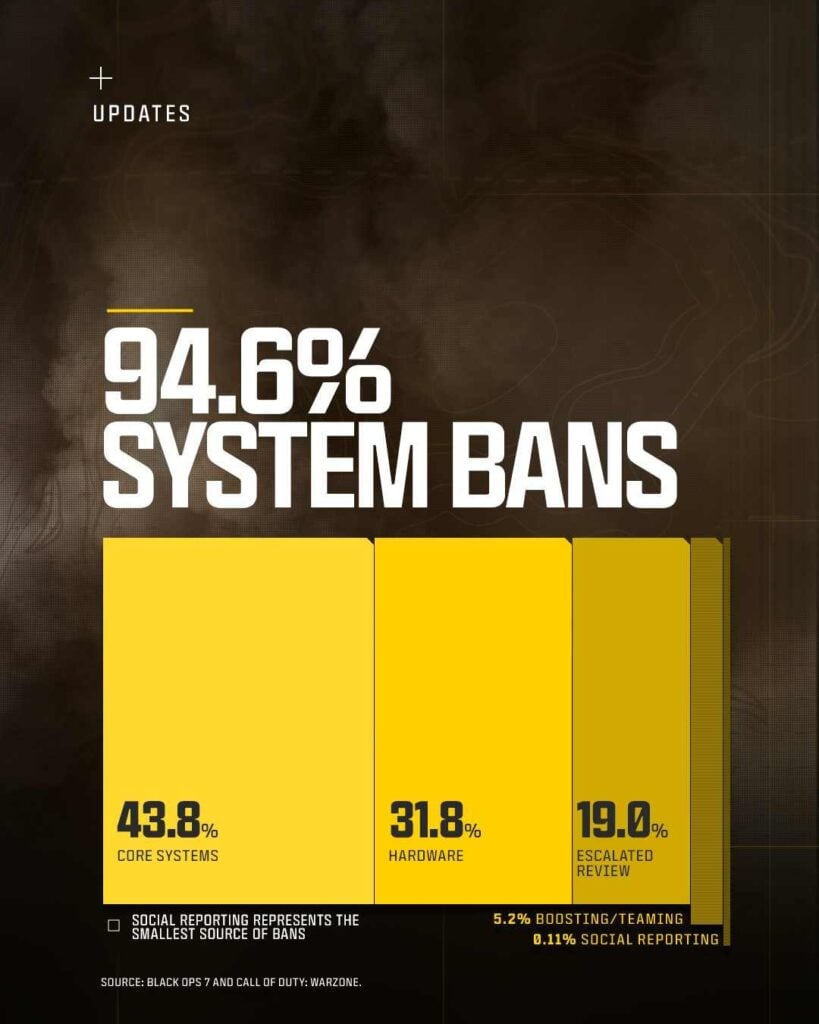
So, RICOCHET’s 2025 year end recap claimed more than 800,000 permanent bans across Black Ops 7, Black Ops 6, and Warzone over that year. The team has also said over 20 cheat makers and dozens of resellers went out of business since Black Ops 6 launched.
Despite all the ban waves, the 2024 exploit that led to thousands of false permabans did real damage to RICOCHET’s credibility, and streamers who insisted for months that they were wrongly banned turned out to have a point. When a system has been wrong before in a way it initially denied, people stop giving it the benefit of the doubt.
Add the fact that a genuine leak did happen in 2021, and you get a community primed to believe the worst version of any new claim.
Treat this as a rumor and nothing more until someone produces something. No evidence, no named source, no corroboration from anyone with a track record, and no acknowledgment from Activision. What we do have is a documented 2021 leak that Activision addressed, an unproven 2021 insider accusation from the same corner of the community, and a fresh set of Season 05 numbers that are getting picked apart in real time.